September 2026
From working student to permanent member of our team: Marcel Ohrenschall studied philosophy and focused on AI theory and AI ethics at LMU Munich, the University of Vienna and the MCMP (Munich Center for Mathematical Philosophy). In a fitting connection to his academic background, he was recently interviewed by Handelsblatt for the article “Warum KI-Unternehmen jetzt Philosophen einstellen” (“Why AI companies are now hiring philosophers”).
But what does the connection between philosophy and AI look like in practice at Content5?
We see great value in the analytical tools that philosophy provides. Understanding complex texts, thinking analytically, structuring knowledge and developing subject-specific expertise are all part of our daily work. More broadly, humanities-based skills have always been an important strength within our team and remain essential for high-quality research.
When Content5 was founded, one argument was often made: if everyone can use Google, professional research is no longer needed. The opposite proved to be true. Finding information is only one part of the process. Sources also need to be assessed, search results placed in context and claims verified. The more information is available, the more important these steps become, and the more expertise is required.
The same applies to AI today. Widespread availability of AI tools does not remove the need to use them critically. Prompts need to be formulated carefully, outputs assessed, sources checked and claims tested for reliability. Unlike conventional search engines, AI models are also far more complex and often function as a kind of black box. This makes specialist knowledge even more important.
A certain level of technical understanding is also necessary to work with AI reliably. Here, too, our new colleague’s academic background supports our work, for example, in developing our own research tools to improve internal processes. At the same time, a deeper understanding of AI helps us assess the limitations of these systems realistically and remain critical where necessary.
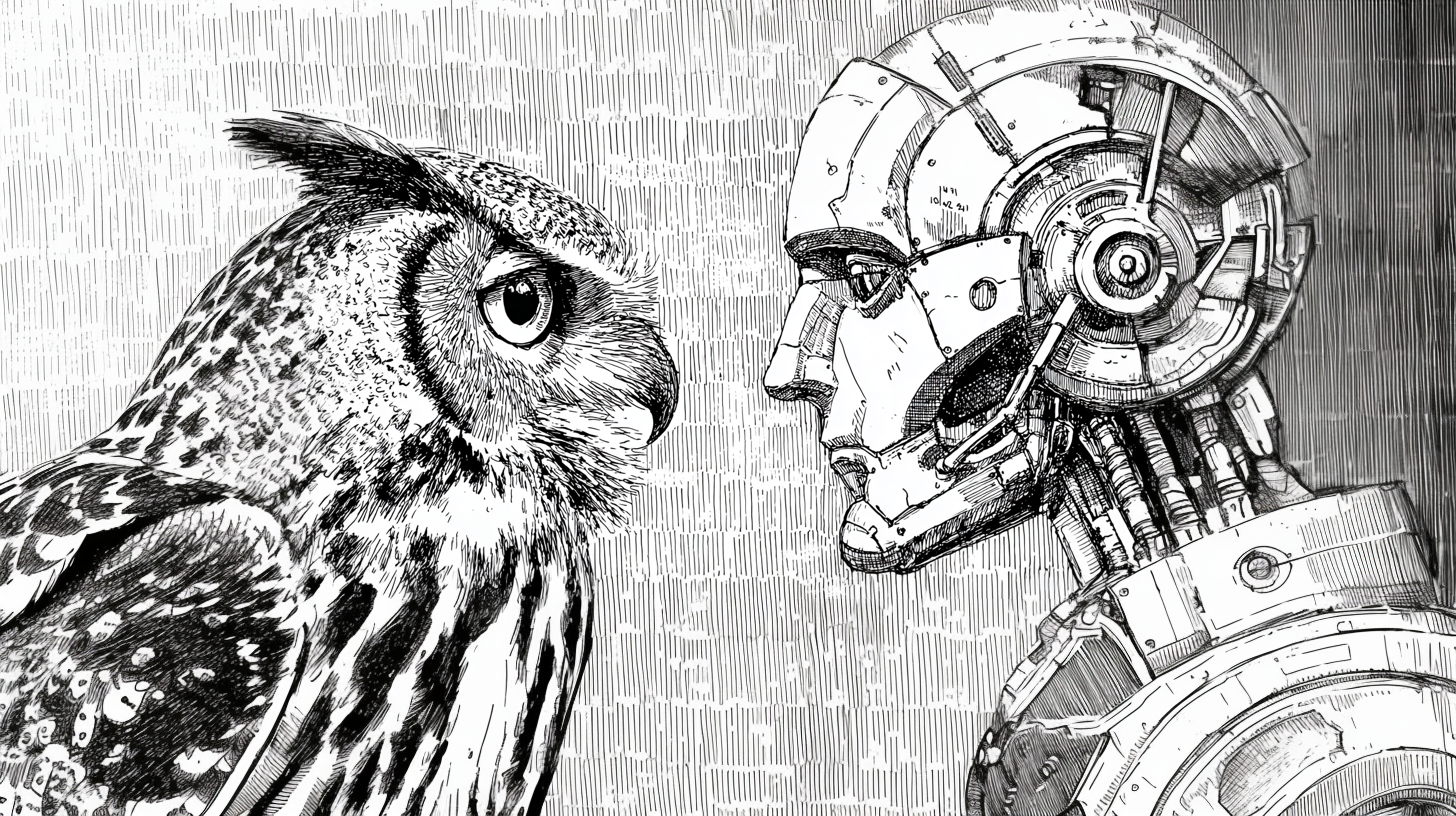
At Content5, the connection between philosophy and AI is therefore not purely theoretical. It has very practical relevance to our work. We are convinced that finding reliable information, assessing the truth and plausibility of claims and critically evaluating sources are skills taught across many humanities disciplines — and skills that are becoming increasingly important in the age of generative AI. Developments such as the establishment of the Artificial Intelligence Safety Institute (AISI) Germany and the EU research project AIOLIA, both of which we have previously covered, underline the growing importance of these capabilities.
© [2026] [AI generated] Marcel Ohrenschall. Based on works by Andreas Ohrenschall.